NOAA Fisheries dates the North Atlantic right whale calving season from mid-November through mid-April, which puts the opening of this season in the past few days. The organized shoreline surveys that watch this stretch of coast have a different start date. The Marineland Right Whale Project's first survey day for the coming season is Monday, January 4, 2027.
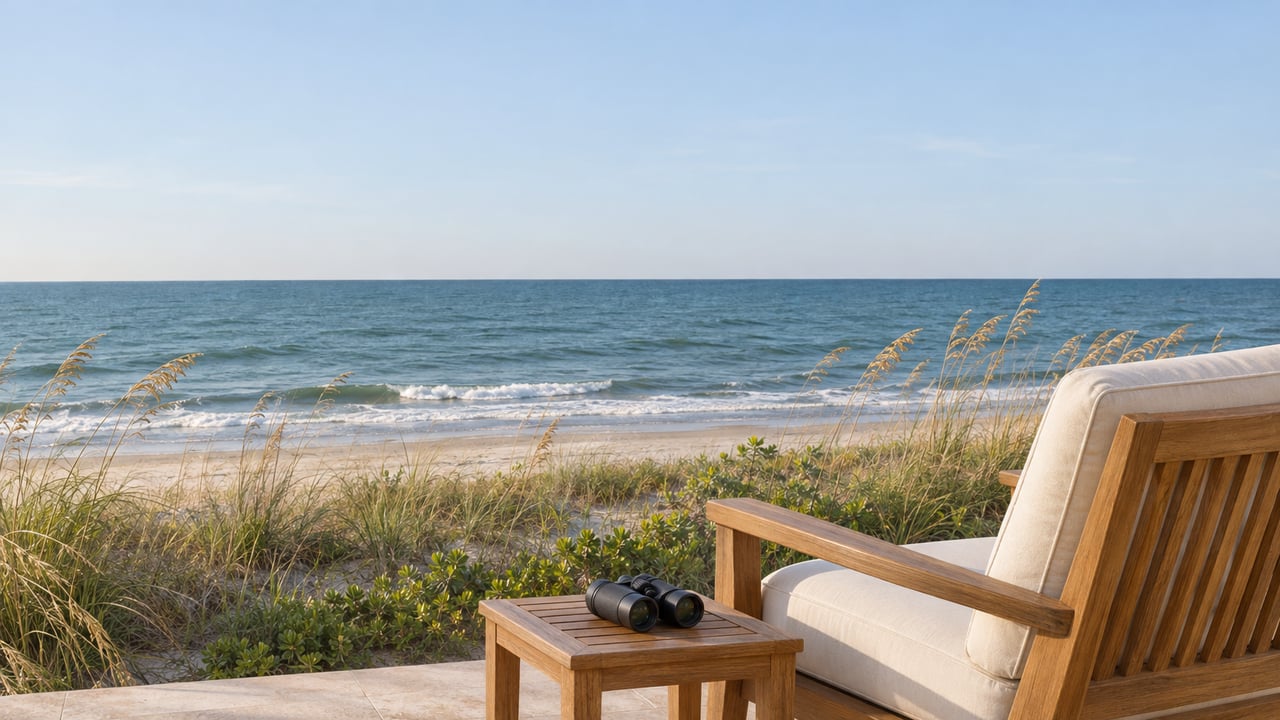
The project's survey area also begins here. Its coverage starts at Ponte Vedra Beach and runs about 70 nautical miles south to Ponce Inlet. Old Ponte Vedra sits at the northern end of that coastline, and the formal survey calendar starts weeks after the whales can arrive. Until then, sightings off this beach depend mostly on whoever happens to be looking out from a Ponte Vedra Boulevard window, a dune walkover or a morning walk near Mickler's Landing.
The Seven Weeks Before the Clipboards Come Out
The volunteer network runs on a tight routine. The Marineland Right Whale Project divides its coastline into seven sectors with four to six lookout points each. Mobile teams of two or more meet at 8:00 a.m., drive to each point, visit every site in their sector twice and scan for 20 minutes at each stop with binoculars and data sheets. Four private communities run their own teams, watching from shorefront units or community dune walkovers. The northernmost sector is labeled 1 North, and the project's 2024–25 records list South Ponte Vedra Beach in that sector.
All of that runs from January 4 through the last survey day on Saturday, March 13, 2027. The project itself describes the whales' presence here as running from December through March. NOAA's mid-November start date and the January survey start leave roughly seven weeks of open season without scheduled coverage.
Whales do turn up in that stretch. Last season, NOAA reports that right whale #3593 was photographed with her calf on January 8, 2026, about 15 miles off Jacksonville Beach. Her calf was much larger than the season's other newborns, which means it was born well before anyone documented it. The first documented mother-calf pair of the season, Champagne and her calf, was recorded on November 28, 2025, off North Carolina.
Last Winter's Ponte Vedra Sighting Started With a Phone Call
On February 12, 2026, at 12:26 p.m., the Florida Fish and Wildlife Conservation Commission got a call from someone who had seen an adult whale heading south off Ponte Vedra. FWC passed the report to the Marineland project. According to the project's sightings log, Team 1N went to the caller's private residence and confirmed a mother and calf. The pair stayed visible from that spot, so no broader alert went out.
The drone pilot had a hard day. In sea state 5, Jeff Greene's first flight came back without a usable image. He returned for a fresh battery, and on the second flight he identified the mother as Magic, catalog #1243, with her calf. The footage also showed a large pod of dolphins interacting with the calf. NOAA describes Magic as 44 years old with her eighth known calf. An aerial team had first photographed the pair on January 16, 2026, about 10 miles east of Amelia Island. Two days before the Ponte Vedra call, a volunteer team had seen them near Varn Park in Palm Coast.
That one February afternoon involved a homeowner's call, a state agency, a volunteer team and a permitted drone operator. Several other sightings last winter were close to Old Ponte Vedra:
| Date | Whale | Where |
|---|---|---|
| January 6, 2026 | Boomerang, #2503, and calf | Off Vilano Beach |
| January 11, 2026 | Callosity Back, #3760, and calf | Off Mickler's Landing |
| January 19, 2026 | Champagne, #3904, and calf | Sector 1 North, photographed from shore |
| January 23, 2026 | Squilla, #3720, and calf | Offshore of the GTM Research Reserve |
| February 12, 2026 | Magic, #1243, and calf | Off Ponte Vedra, confirmed from a private home |
Each of these whales has a history. Callosity Back is the only North Atlantic right whale known to have callosities on her back rather than just on her head. Squilla was first documented with her calf on December 11, 2025, off South Carolina, and she brought the calf back past the GTM Reserve again in February. Boomerang, 31 years old and with her fifth known calf, gets her name from a boomerang-shaped scar under her fluke.
The wider season was a strong one. NOAA's season-close summary counted 23 calves, the most since 2009, and 20 of the 23 mothers had calved before. NOAA says that with the current number of breeding females, 20 newborns in a season would count as relatively productive. Its 2026 season page now lists 24 calves. The added pair was found in September near Anticosti Island, Quebec, where the mother, Silt, was seen with a calf whose birth date and location are unknown.
Reading the Water From a Ponte Vedra Boulevard Window
A good number of these sightings happened close to shore. The project says right whales in northeast Florida often come in near the beach, sometimes within a quarter mile. The 23rd calf of last season was a clear example. On March 14, FWC's aerial team photographed Mirror, #4617, with her new calf about a quarter mile off Crescent Beach. That sighting began with a call to the Right Whale Hotline from a beach walker and her husband, according to the project. By evening, volunteers had tracked the pair south past Marineland.
The project's right whale guide lists the features to look for:
- A V-shaped blow
- No dorsal fin
- Callosities on the head, which look white because of whale lice
- Dark coloring
- Wide flippers
- A broad, notched fluke
Dolphins have dorsal fins and right whales do not. A V-shaped blow with no fin following it is the sign to pick up the phone. Weather affects visibility too. On February 16, two mother-calf pairs were in the survey area, but wind and whitecaps made them hard to see from shore.
Who Gets the Call, and How Close Is Too Close
There are two hotlines, and both route sightings to people who can respond. The Marineland project's partner, Blue World Research Institute, runs the Right Whale Hotline at 888-979-4253, also listed as 888-97-WHALE. BWRI staff follow up with callers and notify the project's response teams when a sighting falls in its area. NOAA Fisheries asks people from North Carolina to Florida to report sightings to 877-WHALE-HELP, which is 877-942-5343. Sightings can also go to the Coast Guard on VHF channel 16 or through the Whale Alert app.
NOAA asks callers to include:
- Date and time of day
- Location, whether coordinates or a nearby landmark
- Your contact information
- A description of the whale, including tail, flippers, head or visible scars
- Photos or video taken without approaching
- Any other details from the sighting
The distance rule matters for anyone who gets in the water. NOAA's regulations prohibit approaching or staying within 500 yards of a right whale, which is 1,500 feet or about five football fields. The rule covers vessels and aircraft, including drones, and people on surfboards, kayaks and jet skis. A vessel already inside 500 yards has to leave immediately. NOAA's enforcement hotline for possible violations is 800-853-1964 and is staffed around the clock. The drone footage in the Marineland sightings log is taken under a NOAA research permit. The project notes that flying within 500 yards of a right whale without one is illegal. This is a summary of federal guidance and not legal advice. For anything specific to your boat, board or drone, check NOAA's own pages or a qualified professional.
Three Ways Into the Network Before January 4
The Marineland project's volunteer application describes three roles, and oceanfront homeowners fit naturally into two of them.
Casual observer. No team and no schedule. You learn the right whale's features and call 888-979-4253 when you see one, whether you're on the beach or at home.
Community survey team. These groups watch from one fixed spot, such as an oceanside condo or community lookout. Turtle Shores in Ponte Vedra Beach is one of four communities listed on the volunteer application, along with Surf Club, Cinnamon Beach and Hammock Dunes in Palm Coast.
A new community team. A community that isn't listed can start its own team if a resident agrees to serve as Team Leader. The leader recruits neighbors, coordinates their watches and stays in touch with the project. The project asks prospective leaders to email [email protected] with the community's name, address and a likely number of volunteers. Ponte Vedra Boulevard has continuous ocean views and sits at the northern edge of the survey area, which makes it a natural spot for one.
The project has already posted its 2027 calendar:
- Beginning of Season Meeting, Sunday, January 3, 2027, 1:30 to 4:00 p.m.
- First day of surveys, Monday, January 4, 2027
- Mid-Season Meeting, Saturday, February 6, 2027, 1:30 to 4:00 p.m.
- Last day of surveys, Saturday, March 13, 2027
- End of Season Meeting, Sunday, March 21, 2027, 1:30 to 4:00 p.m.
The project began in 2001 and now has more than 250 volunteers. Until surveys start, the people watching this stretch of beach are mostly the ones who already live along it.
Watching the ocean from home is a big part of owning on the water in Old Ponte Vedra, and so is knowing how a particular stretch of beach changes through the year. If you're considering a home on Ponte Vedra Boulevard or want to know what your oceanfront property is worth right now, Tyler Ackland and Susan Fort can walk you through it in person. Schedule Your Private Consultation.